Updated February 2026
Join The Conversation
EVERYONE benefits from Visual Aids!

Are you supporting an individual with Down Syndrome? What is the greatest challenge you deal with as a caregiver? Leave me a comment here, and join the conversation on Facebook where I asked, “The great challenge I face supporting an individual with Down Syndrome is_____________.”
Workshop Presentation - Visual Aids and Strategies
EVERYONE benefits from Visual Aids!

Contact Vizually Speaking today to learn how customized Visual Aids and Strategies can decrease undesired behaviour, improve communication, promote independence, and increase self-confidence. Through our dynamic interactive workshop, you will:
✓ Uncover the importance of using customized Visual Aids and Strategies.
✓ Explore the wide range of benefits of customized Visual Aids and Strategies.
✓ Learn practical ways to overcome communication barriers.
✓ Support independence and decrease undesired behaviours.
✓ Access NEW and valuable resources.
Down Syndrome



Down syndrome is the most common chromosomal variation and is not a disease, defect, or illness.
Humans are made up of genetic material called genes, which are inherited from each parent. Genes are organized into structures called chromosomes. Most people have 23 pairs of chromosomes, with one set inherited from each parent.
Down syndrome occurs when an individual has a full or partial extra copy of chromosome 21. This additional genetic material affects how cells develop, leading to the physical, learning, and health characteristics associated with Down syndrome. A chromosomal analysis called a karyotype is used to confirm the diagnosis.
Each person with Down syndrome is unique. Characteristics vary widely and may present in different combinations and degrees. Individuals may experience mild to more significant cognitive delays and may also have associated health considerations such as congenital heart differences, hearing or respiratory challenges, thyroid conditions, or low muscle tone.
Some common physical traits may include short stature, small ears, a flatter facial profile, a single crease across the palm, low muscle tone, and differences in eye shape or limb size. Not all individuals will have the same traits.
In Canada, Down syndrome occurs in approximately 1 in every 800 live births (Canadian Down Syndrome Society). cdss.ca
With appropriate supports, inclusive opportunities, and individualized strategies, individuals with Down syndrome can learn, communicate, work, and participate meaningfully in their communities.
Types of Down Syndrome:


Trisomy 21
Trisomy 21 occurs when chromosome 21 fails to separate properly during cell division before or at conception. As a result, an extra copy of chromosome 21 is present and is replicated in each cell as the embryo develops.
This form of Down syndrome accounts for approximately 95% of all cases (National Down Syndrome Society). ndss.org
Translocation
Translocation occurs during cell division when part of chromosome 21 breaks off and attaches to another chromosome, most commonly chromosome 14. Although the cells contain the usual 46 chromosomes, the presence of extra genetic material from chromosome 21 results in the characteristics associated with Down syndrome.
Translocation accounts for approximately 3% of all Down syndrome cases. cdss.ca
Mosaicism
Mosaicism occurs when chromosome 21 fails to separate properly during one of the early cell divisions after fertilization. As a result, some cells contain an extra copy of chromosome 21 (47 chromosomes), while other cells have the typical 46 chromosomes.
This form of Down syndrome accounts for approximately 2% of cases (Canadian Down Syndrome Society). cdss.ca
Prenatal screening can help identify the chance that a pregnancy may be affected by Down syndrome. Screening typically includes maternal blood tests and ultrasound examinations, which estimate risk but do not provide a diagnosis. If screening indicates a higher likelihood, diagnostic testing may be offered to confirm whether an extra copy of chromosome 21 is present.
Customized visual aids and strategies are especially effective for people with Down syndrome because they align with common learning strengths while supporting areas that may be more challenging. When visual aids and strategies are customized, they make information clear, predictable, and easier to understand. They can significantly improve understanding, independence, behaviour, and quality of life across all ages.
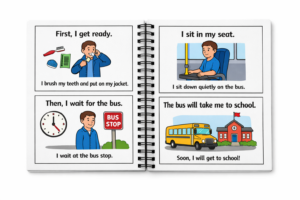
Customized visual aids and strategies support people with Down syndrome by making information clear, predictable, and easier to understand. Visual aids such as schedules, task breakdowns, and choice boards strengthen communication, support learning, and reduce reliance on verbal instructions.
By clearly showing expectations and routines, visual aids help reduce anxiety and behaviour related to uncertainty while promoting independence, confidence, and participation. When customized to the person’s strengths and daily life, visual aids and strategies provide meaningful engagement and improved quality of daily living across the lifespan.
Vizually Speaking understands that finding time in today’s highly demanding world to create customized visual aids and strategies can be a great challenge. Vizually Speaking is committed to working collaboratively, providing step-by-step support and assisting in the development and implementation of customized visual aids and strategies.
Contact us today for your FREE consultation.
Behaviour & Down Syndrome
Behavioural challenges in individuals with Down syndrome are usually similar to those seen in others at the same developmental level. However, they may occur more often or feel more intense at times.
Behaviour is a form of communication. It may signal frustration, confusion, fatigue, anxiety, or difficulty understanding what is expected—especially when communication, language, or processing is challenging. Many individuals use self-talk as a way to process information or regulate themselves, and this is typically not a concern.
Health and well-being play an important role. Vision or hearing differences, sleep apnea, anxiety, pain, or other medical conditions can strongly influence behaviour and should always be considered.
Some behaviours you may notice include wandering or running, attention difficulties, rigidity or stubbornness, oppositional behaviour, and repetitive or obsessive interests. Autism spectrum disorder also occurs in approximately 5–7% of individuals with Down syndrome.
Customized visual aids and strategies—such as schedules, choice boards, and step-by-step visuals—help make expectations clear, reduce frustration, and support calmer, more positive behaviour by improving understanding and communication.


How Customized Visual Aids Help
✓ Builds understanding and learning
✓ Supports expressive and receptive communication
✓ Increases independence and confidence
✓ Reduces anxiety and supports behaviour
✓ Supports memory and processing
✓ Adapts across the lifespan
✓ Respects individual strengths and needs
Examples of Customized Visual Aids
✓ Daily and weekly visual schedules
✓ Task breakdowns (e.g., hygiene, cooking, work tasks)
✓ Choice boards and communication boards
✓ Visual rules and social expectations
✓ Visual supports for behaviour and emotional regulation
When thoughtfully designed and consistently used, customized visual aids and strategies empower people with Down syndrome to communicate more effectively, participate more fully, and experience greater success and quality of daily living.
Vizually Speaking understands that finding time in today’s highly demanding world to create customized visual aids and strategies can be a great challenge. Vizually Speaking is committed to working collaboratively, providing step-by-step support and assisting in the development and implementation of customized visual aids and strategies.
Contact us today for your FREE consultation.
Aging & Down Syndrome
In the past, many individuals with Down syndrome were not expected to live beyond early adulthood. Today, thanks to advances in medical care, including improved heart treatments and overall health supports, many people with Down syndrome are living longer, fuller lives—often into their 60s and beyond.
As individuals age, some adults with Down syndrome may experience changes in the brain similar to those seen in Alzheimer’s disease, sometimes beginning in their 40s. It’s important to know that these changes do not always lead to dementia, and many people continue to enjoy meaningful relationships, activities, and daily routines.
With regular medical care, supportive environments, and thoughtful planning, families can help their loved ones with Down syndrome age with dignity, comfort, and quality of life. Ongoing research continues to enhance the understanding and support for healthy aging within the Down syndrome community.


Supporting Memory, Routines, and Transitions with Visual Supports
As individuals with Down syndrome age, changes in memory, processing speed, or flexibility may occur. Visual supports can play an important role in maintaining independence, reducing anxiety, and supporting daily success.
Tools such as visual schedules, routine strips, checklists, calendars, and step-by-step task visuals help make daily activities more predictable and easier to follow. Visuals can support understanding of what is happening now, what comes next, and when a transition will occur, which can be especially helpful during times of change.
For adults who experience memory changes, visual supports provide gentle reminders and reduce the need to rely solely on verbal information. Familiar images, photographs, or symbols can support comfort, confidence, and continued participation in everyday life.
When thoughtfully individualized, visual strategies help individuals with Down syndrome maintain routines, adapt to transitions, and age with dignity and quality of life, while also supporting families and caregivers.
Down syndrome occurs in all populations worldwide, regardless of race, culture, or socioeconomic background. Research shows that the likelihood of having a child with Down syndrome increases with maternal age, although most children with Down syndrome are born to younger parents due to higher overall birth rates in this group.

Vizually Speaking understands that finding time in today’s highly demanding world to create customized visual aids and strategies can be a great challenge. Vizually Speaking is committed to working collaboratively, providing step-by-step support and assisting in the development and implementation of customized visual aids and strategies.
Contact us today for your FREE consultation.
RELATED LINKS:
down-syndrome.org
thearc.org
ds-int.org
ndss.org
cdadc.com/ds/
dsao.ca/
cdss.ca