
Updated February 2026
Workshop Presentation - Visual Aids and Strategies
EVERYONE benefits from Visual Aids!

Contact Vizually Speaking today to learn how customized Visual Aids and Strategies for Caregivers/Parents can decrease undesired behaviour(s), improve communication, promote independence, and increase self-confidence. Through our dynamic presentation, you will:
✓ Uncover the importance of using customized Visual Aids and Strategies.
✓ Explore the wide range of benefits of customized Visual Aids and Strategies.
✓ Learn practical ways to overcome communication barriers.
✓ Support independence and decrease undesired behaviours.
✓ Access NEW and valuable resources.
What does the research say about visual aids and strategies? There is an increasing amount of research validating the use of visual aids and strategies.
The Use of Visual Supports to Facilitate Transitions of Students With Autism
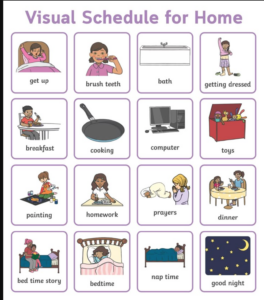
Visual supports were used to aid transitions from one activity to another for two elementary boys. Data revealed a significant decrease in the latency between the time the students were given instructions and the time they began the next activity when the visual supports were used. Visual supports also resulted in a significant decrease in teacher-delivered verbal and physical prompts during a transition. – Dettmer, S., Simpson, R.L., Myles, B.S., & Ganz, J.B. (2000). Focus on Autism and Other Developmental Disabilities, 15, 163-169.
Using an Activity Schedule to Smooth School Transitions
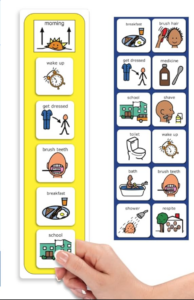
Functional assessment of a preschool child’s aggressive and disruptive behaviors identified antecedent conditions associated with difficulties during transitions from one activity to another. A schedule board produced a dramatic decrease in aggression and an increase in cooperative behavior in the classroom. – Journal of Positive Behavior Interventions, Vol. 3, No. 1, 57-61 (2001)
Teaching Daily Living Skills to Children with Autism in Unsupervised Settings Through Pictorial Self-Management
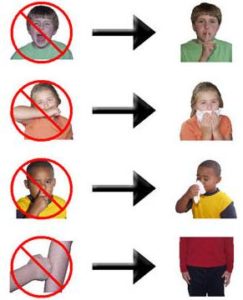
Study of 3 low-functioning children (ages 6-9) with autism found children could successfully use pictures to manage their self-care behavior in the absence of a treatment provider, generalize their behavior across settings and tasks, and maintain behaviors at follow-up. When picture order was manipulated, subjects followed the new picture sequence. – Pierce, K.L. & Schreibman, L. (1994). Journal of Applied Behavior Analysis, Vol. 27, No. 3, pp. 471-481
Effects of Using Photographic Cueing Package During Routine School Transitions with a Child Who Has Autism
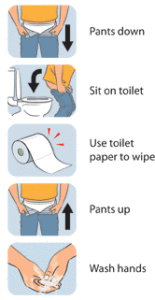
Photo cues were used for teaching a 6-year-old with autism to make successful transitions in daily routines. Providing advance notice of an activity change using combined verbal and photo cues helped reduce child’s tantrums while increasing number of appropriate transitions.- Schmit, J., Alper, S., Raschke, D., & Ryndak, D. (2000). Mental Retardation, 38, 131-137.
Using an Instructional Package Including Video Technology to Teach Self-Help Skills to Elementary
Video modeling and video prompting were used to successfully teach 3 self-help skills (cleaning sunglasses, putting on a wristwatch, and zipping a jacket) to 3 elementary students with mental disabilities. – J.M. Norman, BC Collins, J.W. Schuster – Journal of Special Education Technology, 2001
Vizually Speaking understands that finding time in today’s highly demanding world to create customized visual aids and strategies can be a great challenge. Vizually Speaking is committed to working collaboratively, providing step-by-step support and assisting in the development and implementation of customized visual aids and strategies.
Contact us today for your FREE consultation.