Updated February 2026
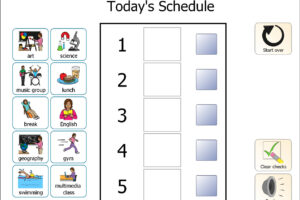
A task list is a visual aid that is a structured sequence of steps breaking a task or activity into smaller, manageable components, typically presented in a numbered format with a “Done” or “Finished” column. Task lists visual aids support individuals in remaining on task and completing activities independently by providing clear, visual guidance.
Vizually Speaking understands that finding time in today’s highly demanding world to create customized visual aids and strategies can be a great challenge. Vizually Speaking is committed to working collaboratively, providing step-by-step support and assisting in the development and implementation of customized visual aids and strategies.
Contact us today for your FREE consultation.
Workshop Presentation - Visual Aids and Strategies
EVERYONE benefits from Visual Aids!

Contact Vizually Speaking today to learn how customized Visual Aids and Strategies can decrease undesired behaviour(s), improve communication, promote independence, and increase self-confidence. Through our dynamic presentation, you will:
✓ Uncover the importance of using customized Visual Aids and Strategies.
✓ Explore the wide range of benefits of customized Visual Aids and Strategies.
✓ Learn practical ways to overcome communication barriers.
✓ Support independence and decrease undesired behaviours.
✓ Access NEW and valuable resources.
It’s common to feel overwhelmed when managing multiple tasks and routines. For individuals with autism or executive functioning challenges, remembering and organizing tasks can be especially difficult. Customized visual task lists help break tasks into manageable steps, reduce anxiety, and provide a clear structure, allowing individuals to see what needs to be done and what has already been completed.
Customized visual to-do lists support organization, reduce overwhelm, and help individuals clearly see what needs to be done and what has already been completed. They are especially helpful for individuals with autism or executive functioning challenges who benefit from predictable structure and visual clarity.
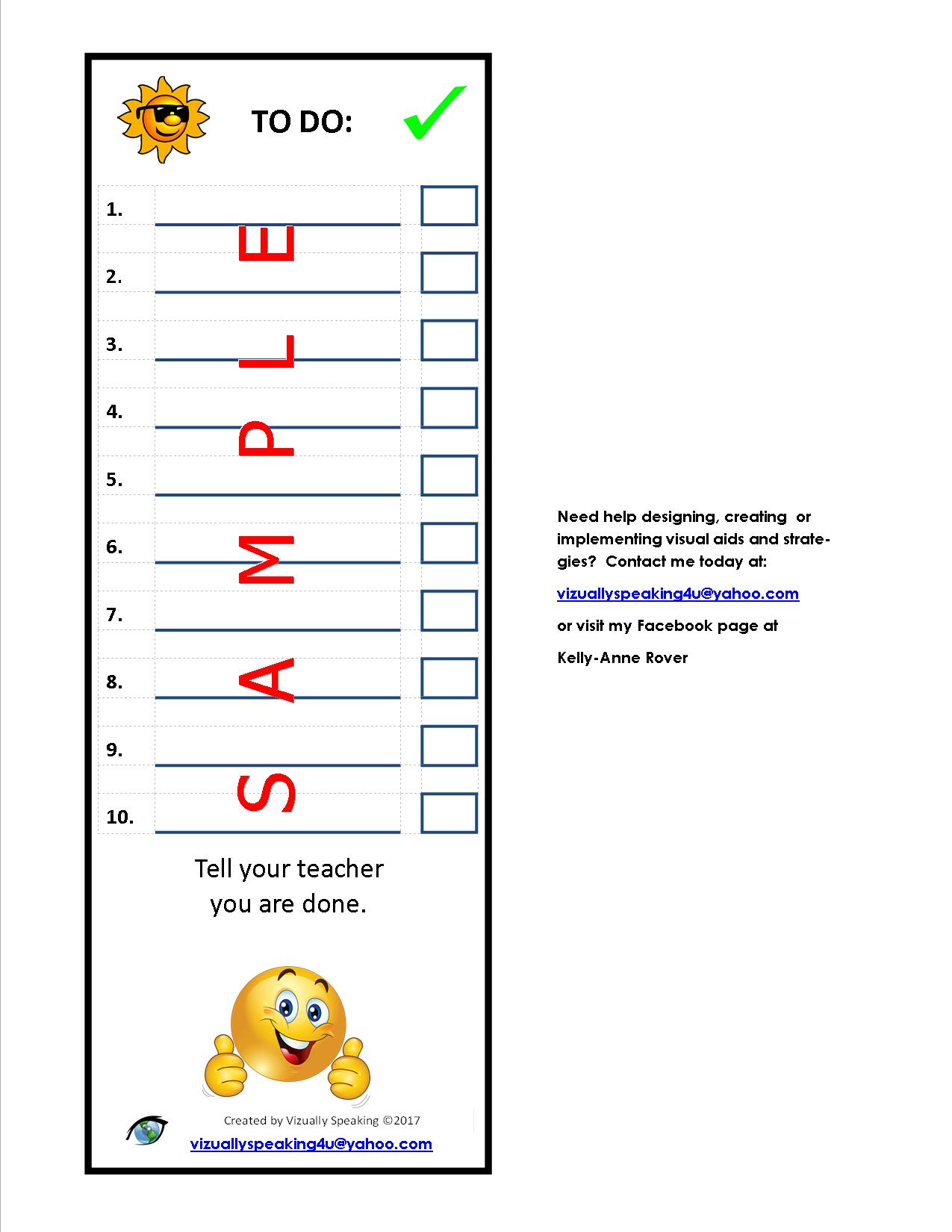
Examples of visual to-do lists include:
-
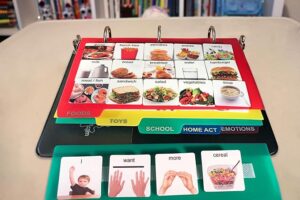
Icon-based lists: Tasks represented by pictures or symbols (e.g., a toothbrush for brushing teeth, a book for homework, shoes for going outside).
-
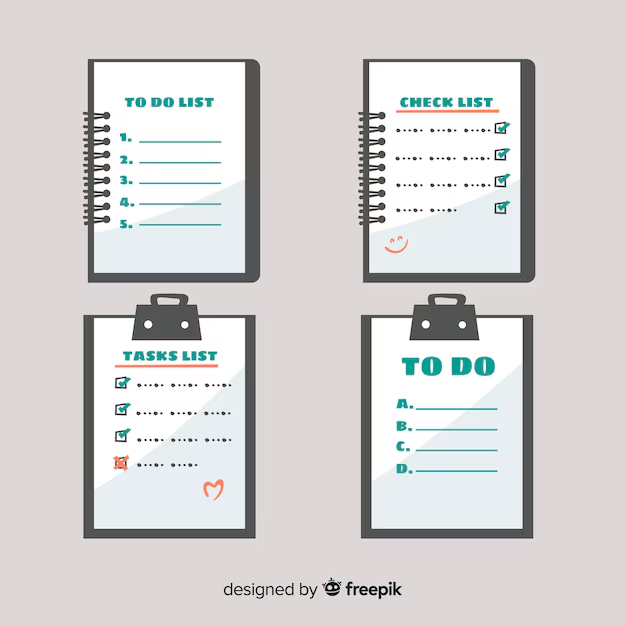
Checkbox lists: Written or visual tasks with checkboxes that can be marked, crossed off, or Velcro-removed when completed.
-
First–Then boards: A simple two-step visual showing what must be done first and what comes next (e.g., First homework, Then play).
-
Visual schedules: A sequence of activities displayed using pictures, symbols, or words to outline daily routines (e.g., morning routine, after-school routine).
-
Removable task cards: Individual task cards placed on a board or strip and removed as each task is completed, providing a clear sense of progress.
Creating a Task List
Creating a Task List may be easy for yourself; however, there are a few things you should consider when you are creating it for someone else:
✓ Decide what medium works best.
A phone note, an app, a computer screen, a pen and pencil, or a customized visual aid? Something else?
✓ List all the tasks or manageable segments that need to accomplish.
Tasks may vary in type, priority, and the amount of time required to complete them.
✓ Estimate the time each task or segment will take.
Be realistic! If the individual constantly feels like they are running out of time to get the task or list completed, they will feel unnecessary stress, which may result in undesired behaviours.
✓ Make the list aesthetically-pleasing.
Although it may appear minor, this strategy can significantly influence how the individual engages with and responds to the task list.
✓ Put the task list somewhere they will see it regularly.
Ensure the task list is always visible to the individual. Being able to see completed tasks provides motivation, reinforces progress, and supports follow-through.

Acknowledge and reinforce any attempt to complete a task, even if the outcome is not exactly as expected. Maintaining a positive and encouraging approach helps motivate the individual and supports persistence.
Vizually Speaking understands that finding time in today’s highly demanding world to create customized visual aids and strategies can be a great challenge. Vizually Speaking is committed to working collaboratively, providing step-by-step support and assisting in the development and implementation of customized visual aids and strategies.
Contact us today for your FREE consultation.