Last updated: February 2026
Vizually Speaking understands that finding time in today’s highly demanding world to create customized visual aids and strategies can be a great challenge. Vizually Speaking is committed to working collaboratively, providing step-by-step support and assisting in the development and implementation of customized visual aids and strategies.
Contact us today for your FREE consultation.
Workshop Presentation - Visual Aids and Strategies
EVERYONE benefits from Visual Aids!

Contact Vizually Speaking today to learn how customized Visual Aids and Strategies can decrease undesired behaviour(s), improve communication, promote independence, and increase self-confidence. Through our dynamic presentation, you will:
✓ Uncover the importance of using customized Visual Aids and Strategies.
✓ Explore the wide range of benefits of customized Visual Aids and Strategies.
✓ Learn practical ways to overcome communication barriers.
✓ Support independence and decrease undesired behaviours.
✓ Access NEW and valuable resources.
What Are Communication Books?
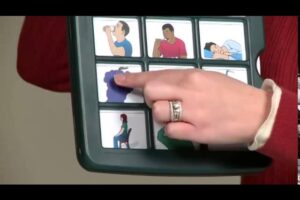
Communication books are personalized visual communication tools that help individuals express their needs, wants, preferences, thoughts, and ideas when speech is difficult or not possible. They are commonly used as part of Augmentative and Alternative Communication (AAC) within the field of Speech-Language Pathology.
A communication book typically contains visual symbols, photos, words, or short phrases organized into themed pages. These visual supports allow a person to communicate by pointing to, touching, or showing images or words that represent what they want to say.
Communication books are designed to be portable, durable, and easy to use, making them practical communication supports in everyday environments such as home, school, therapy sessions, workplaces, and healthcare settings.
Who Benefits from Communication Books?
Communication books support individuals of all ages who experience speech, language, or communication challenges. They are commonly used by individuals with:
-
Autism Spectrum Disorder
-
Cerebral Palsy
-
Down Syndrome
-
Childhood Apraxia of Speech
-
Aphasia
-
Traumatic Brain Injury
-
Amyotrophic Lateral Sclerosis
Communication books can also support individuals who:
-
Temporarily cannot speak due to illness, surgery, or hospitalization
-
Have developmental delays
-
Experience communication barriers in new environments or unfamiliar situations
Families, educators, therapists, and healthcare professionals also benefit from communication books because they provide clear ways to understand and support the individual’s communication.
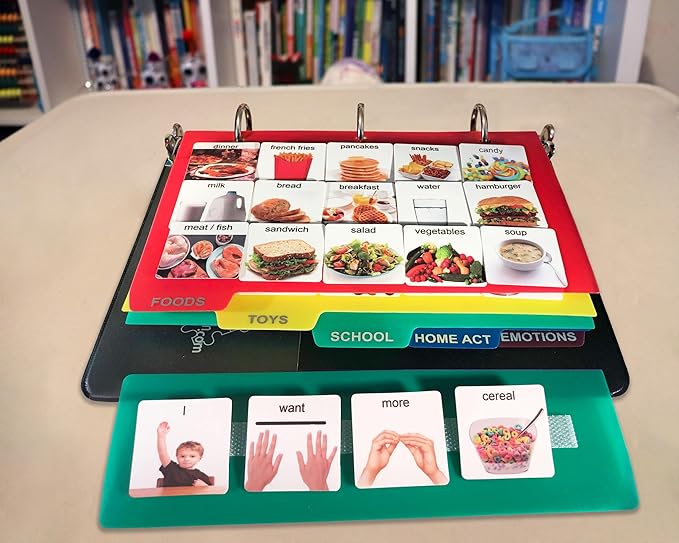
Communication books are typically developed over time in response to individual use and communication needs. While many pages reflect familiar and frequently used vocabulary, unfamiliar words may be intentionally included to support vocabulary development and language expansion.
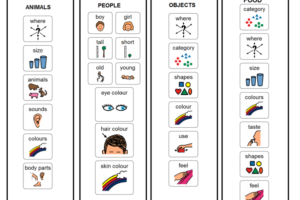
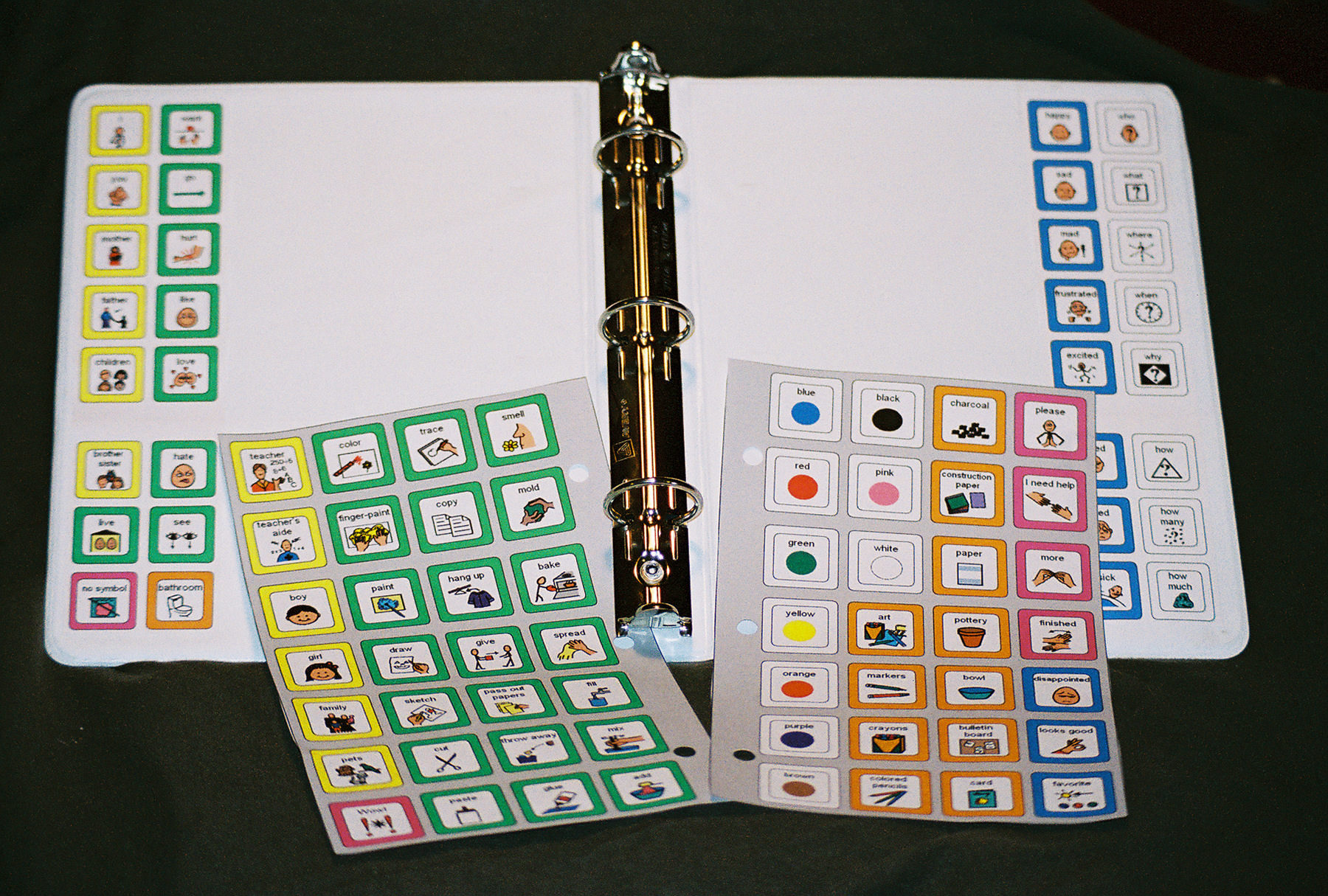
Communication books commonly include topic pages such as About Me, People, Feelings, Clothes, Food, Drinks, Animals, Colours, Numbers, Letters, Hobbies, and Interests. Additional topics to consider include Weather, Places, Activities, and Adjectives, depending on the individual’s communication goals and daily environments.
Why Use a Communication Book?
Communication books provide a reliable and accessible way to communicate when spoken language is limited or unavailable.
Key Benefits
Supports independence
Individuals can communicate choices, needs, and opinions without relying on others to interpret or guess.
Reduces frustration
Being able to express thoughts clearly often reduces communication breakdowns and frustration.
Encourages language development
Including both familiar and new vocabulary helps support language learning and vocabulary expansion.
Works across environments
Communication books can be used at home, school, therapy sessions, workplaces, and in the community.
Accessible and portable
Unlike many electronic AAC devices, communication books do not require batteries, charging, or internet access.
Vizually Speaking understands that finding time in today’s highly demanding world to create customized visual aids and strategies can be a great challenge. Vizually Speaking is committed to working collaboratively, providing step-by-step support and assisting in the development and implementation of customized visual aids and strategies.
Contact us today for your FREE consultation.
How Communication Books Are Designed
Communication books are individualized to the user. The number of symbols per page and the type of vocabulary included depend on the person’s:
-
Age
-
Cognitive level
-
Physical abilities
-
Communication goals
-
Daily environments
-
Personal interests
For some individuals, a page may contain one large symbol, while others may use multiple symbols per page to support more complex communication.
Communication books developed for adults often focus on functional vocabulary related to:
-
Employment
-
Shopping
-
Healthcare appointments
-
Interactions with support workers
-
Community participation
Common Communication Book Topics
Communication books commonly include themed pages such as:
-
About Me
-
People
-
Feelings
-
Clothes
-
Food
-
Drinks
-
Animals
-
Colours
-
Numbers
-
Letters
-
Hobbies and Interests
Additional topics may include Weather, Places, Activities, and Describing Words, depending on the individual’s communication goals and daily routines.
If a topic becomes too large, it may be divided into multiple pages to keep navigation simple and organized.
Organization and Navigation
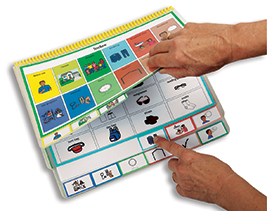
Many communication books include a main topic page at the front with icons linking to other sections such as Food, Toys, People, and Feelings. These links may be organized using numbers, colours, letters, or tabs.
To make communication faster and easier, books may also include:
Quick-access words
A flip-out or detachable strip with frequently used words like more, help, finished, yes, and no.
Sentence starters
Topic pages may include phrases such as:
-
I want
-
I like
-
I don’t like
-
I feel…
Tabs and page fluffers
Laminated tabs, Velcro markers, foam shapes, or textured page markers help users locate pages independently, especially for individuals with fine motor or visual challenges.
Communication Books Grow Over Time
Communication books are living tools that evolve with the individual. As communication skills, interests, and environments change, new vocabulary and pages can be added.
This gradual development helps support increasing independence, language growth, and meaningful participation in everyday life.
Vizually Speaking understands that finding time in today’s highly demanding world to create customized visual aids and strategies can be a great challenge. Vizually Speaking is committed to working collaboratively, providing step-by-step support and assisting in the development and implementation of customized visual aids and strategies.
Contact us today for your FREE consultation.
Why Communication Books Are Important for Caregivers, Health Workers, and Frontline Professionals
Communication books do more than support the individual using them. They also provide essential communication support for caregivers, healthcare professionals, and frontline workers who need to quickly understand and respond to a person’s needs.
Caregivers and Family Members
For parents, family members, and support workers, communication books provide a structured way to understand and support communication.
Benefits include:
-
Helping caregivers understand needs and preferences
- Identify pain, discomfort, or symptoms
-
Supporting daily routines such as meals, hygiene, and activities
-
Reducing frustration and behavioural challenges caused by communication breakdowns
-
Strengthening relationships and social interaction
-
Encouraging independence and self-advocacy
Communication books also help caregivers model language and expand vocabulary, supporting long-term communication development.
Healthcare Professionals
Healthcare providers often need to gather accurate information quickly, particularly when working with individuals who cannot rely on speech.
Communication books help professionals such as nurses, physicians, therapists, and hospital staff:
-
Understand pain, dsicomforts, symptoms, and physical needs
-
Ask yes/no questions or choice-based questions
-
Explain procedures, treatments, and next steps
-
Support patient participation in healthcare decisions
-
Reduce anxiety during medical appointments or hospital stays
In clinical settings, communication books can support individuals with conditions such as:
-
Autism Spectrum Disorder
-
Cerebral Palsy
-
Aphasia
-
Traumatic Brain Injury
This can improve patient safety, comfort, and quality of care.
Vizually Speaking understands that finding time in today’s highly demanding world to create customized visual aids and strategies can be a great challenge. Vizually Speaking is committed to working collaboratively, providing step-by-step support and assisting in the development and implementation of customized visual aids and strategies.
Contact us today for your FREE consultation.
Frontline Workers and Community Support Staff
Frontline workers—including community support workers, educators, transit staff, and customer service personnel—may interact with individuals who use alternative communication methods.
Communication books help frontline professionals:
-
Understand basic requests and needs
-
Offer appropriate assistance
-
Support community participation and accessibility
-
Reduce misunderstandings in public environments
- Promote inclusive communication and accessibility
When communication supports are available, individuals are better able to participate in healthcare, community services, and everyday activities with confidence and dignity.
Emergency Responders
Emergency responders such as paramedics, firefighters, and police officers often encounter individuals who may be unable to speak due to disability, injury, shock, or stress. These communication barriers can create serious safety challenges.
Communication books can help responders quickly determine:
-
If someone is injured or in pain
- Where the pain is located
-
Whether the person has a medical condition
-
If they require medication or assistance
-
Who to contact in an emergency
In high-stress or urgent situations, customized visual aids and strategies can help responders gather critical information quickly, while reducing confusion or fear and improving outcomes in an emergency.
Supporting Communication Across All Environments
Unlike many digital tools, communication books are low-tech, reliable, and easy to use. They do NOT require batteries, internet access, or specialized equipment, making them ideal for use in hospitals, clinics, emergency vehicles, community programs, and public spaces.
By supporting communication between individuals and the people around them—including caregivers, healthcare professionals, frontline workers, and emergency responders—communication books help create safer, more inclusive, and more responsive environments for everyone.
They ensure that individuals with communication challenges are heard, understood, and able to participate meaningfully in decisions that affect their health, safety, and well-being in their daily life.
Vizually Speaking understands that finding time in today’s highly demanding world to create customized visual aids and strategies can be a great challenge. Vizually Speaking is committed to working collaboratively, providing step-by-step support and assisting in the development and implementation of customized visual aids and strategies.
Contact us today for your FREE consultation.