Updated February 2026
Join The Conversation
Are you supporting a client or loved one who has a speech or language disorder? What is the greatest challenge you face? Join the conversation on Facebook, and share your thoughts completing the statement, “My greatest challenge with a speech and language disorder is_____________.”

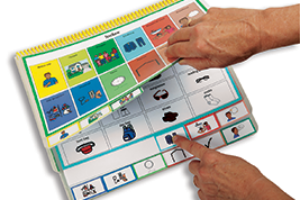
Vizually Speaking provides a service to assist individuals, families, caregivers, frontline workers, Speech and Language Pathologists (SLP), Occupational Therapists (OT), Behavioural Therapists, Physical Therapists (PT), support workers, and other caregivers in designing, creating, and implementing customized visual aids and strategies. Contact us today to book your FREE consultation.
Workshop Presentation - Visual Aids and Strategies
EVERYONE Benefits from Visual Aids!

Contact Vizually Speaking today to discover how customized Visual Aids and Strategies can reduce undesired behaviours, strengthen communication, promote independence, and build self‑confidence. Through our dynamic presentation, you will:
✓ Uncover the importance of using customized Visual Aids and Strategies.
✓ Explore the wide range of benefits of customized Visual Aids and Strategies.
✓ Learn practical ways to overcome communication barriers.
✓ Support independence and decrease undesired behaviours.
✓ Access NEW and valuable resources.
The way we communicate with others and with ourselves ultimately determines the quality of our lives. – Anthony Robbins
Individuals who experience delays or difficulties in communication or language often show undesired behaviours. Language influences behaviour, and behaviour influences language—essentially, behaviour is a form of communication. Delays or disabilities can occur at any age, from infancy through older adulthood, and may stem from physical, developmental, motor, voice, or processing challenges.
When an individual has limited or ineffective communication skills or delays in speech and language development, their ability to express needs and understand others can be significantly affected. If these difficulties go undetected, they can have a lasting impact on communication, self‑esteem, and behaviour.
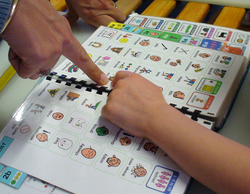
Vizually Speaking provides a service to assist individuals, families, caregivers, frontline workers, Speech and Language Pathologists (SLP), Occupational Therapists (OT), Behavioural Therapists, Physical Therapists (PT), support workers, and other caregivers in designing, creating, and implementing customized visual aids and strategies. Contact us today to book your FREE consultation.
Communication is about sharing stories and information. Just because someone communicates differently from you doesn’t mean that their story or information isn’t worth hearing. – Speech Pathology Australia (SPA) National President Christine Stone.

When communicating with an individual who has a language delay or disability, adopting a “less is more” approach is often most effective. Providing too much information at once can create overload, making it difficult for the individual to process, respond, or stay engaged. Some common types of overload include:
✓ Auditory overload – too much talking, speaking too quickly, multiple people speaking at once, or questions followed by questions with little time to respond
✓ Visual overload – excessive visual stimuli, cluttered environments, or too many visual cues
✓ Emotional overload – heightened stress, frustration, or strong emotions that interfere with processing, resulting in the individual being unable to respond
✓ Cognitive overload – complex instructions, too many steps, abstract language, or communicating something the individual already knows the answer to
✓ Environmental overload – loud noises, busy settings, or unpredictable surroundings
FREE Important and Developmental Milestones Charts
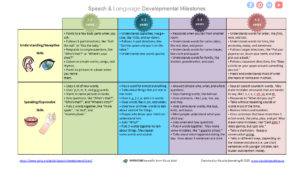
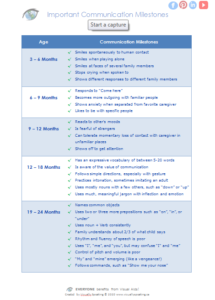
Download yours TODAY!
Just click on the picture.
These FREE developmental charts provide a helpful guideline for the milestones your child may reach as they grow. Please remember that every child develops at their own pace.
These charts reflect when most children who speak only one language typically achieve each milestone. Your child should master the listed skills by the top of the age range. Missing one skill within an age range does not automatically indicate a problem. However, you may want to seek guidance if you answer “no” to most of the listed skills.
These milestones are intended as a general guide. If you have any concerns about your child’s development, please contact your physician or a Speech-Language Therapist.
Vizually Speaking understands that finding time in today’s highly demanding world to create customized visual aids and strategies can be a great challenge. Vizually Speaking is committed to working collaboratively, providing step-by-step support and assisting in the development and implementation of customized visual aids and strategies.
Contact us today for your FREE consultation.